
How to Pass CompTIA Security+ (SY0-701)
Prep smart for CompTIA Security+ SY0-701: the five exam domains, performance-based questions, and a study routine built on active recall to make it stick.
CompTIA Security+ is the go-to entry-level cybersecurity certification — often the first credential that gets you past HR filters for security roles. The current version, SY0-701, is broad and concept-heavy, which is exactly the kind of exam that rewards smart, active studying. Here's how to prep.
Know the exam format first
Per CompTIA's official page, the SY0-701 exam is:
- Up to 90 questions, a mix of multiple-choice and performance-based questions (PBQs) — hands-on tasks in a simulated environment.
- 90 minutes long.
- Scored on a scale of 100–900, with a passing score of 750 (roughly 83%).
The PBQs usually come first and are worth more, so don't burn all your time on them — flag and move on if you're stuck, then come back.
The five domains
Security+ SY0-701 is organized into five weighted domains:
- General Security Concepts (~12%) — CIA triad, AAA, Zero Trust, cryptographic basics.
- Threats, Vulnerabilities & Mitigations (~22%) — attack types, social engineering, malware.
- Security Architecture (~18%) — secure network and system design.
- Security Operations (~28%) — the largest domain: monitoring, incident response, hardening.
- Security Program Management & Oversight (~20%) — governance, risk, policies, compliance.
Because Security Operations is the biggest slice, weight your study toward it — but every domain shows up.
Concepts you must know cold
Security+ is vocabulary- and concept-dense. Get these instant:
- The CIA triad (Confidentiality, Integrity, Availability) and AAA (Authentication, Authorization, Accounting).
- Attack types — phishing, ransomware, DDoS, SQL injection, on-path (MITM), brute force — and which part of the CIA triad each threatens.
- Cryptography — symmetric (AES) vs. asymmetric (RSA), hashing (SHA-256), digital signatures, certificates and CAs.
- Core principles — least privilege, defense in depth, Zero Trust, MFA.
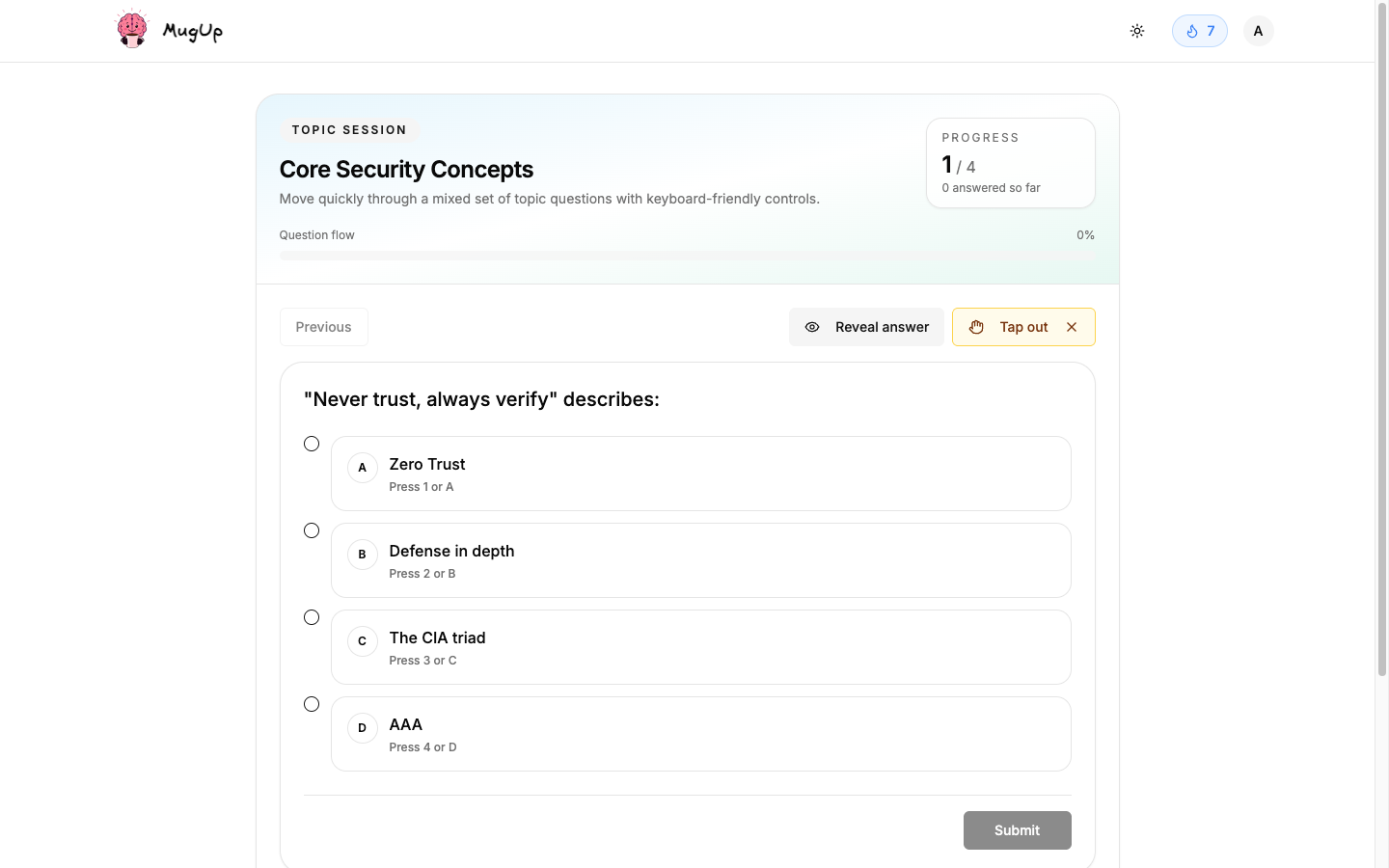
Flashcards are ideal for definitions; matching games are perfect for "attack → description," and fill-in-the-blank drills lock in the crypto distinctions.
A study routine that sticks
- Study to the official objectives. Every question maps to CompTIA's published objectives — that's your checklist.
- Turn each domain into questions as you learn it, rather than rereading notes.
- Test yourself daily. Active recall is what moves concepts into long-term memory — here's why.
- Space out your reviews so earlier domains don't fade while you learn new ones.
- Practice PBQs separately — get comfortable with the simulated-task format before exam day.
- Watch a video series (many are free) for the concepts, then drill with practice questions — the drilling is where the retention happens.
Drill it with MugUp
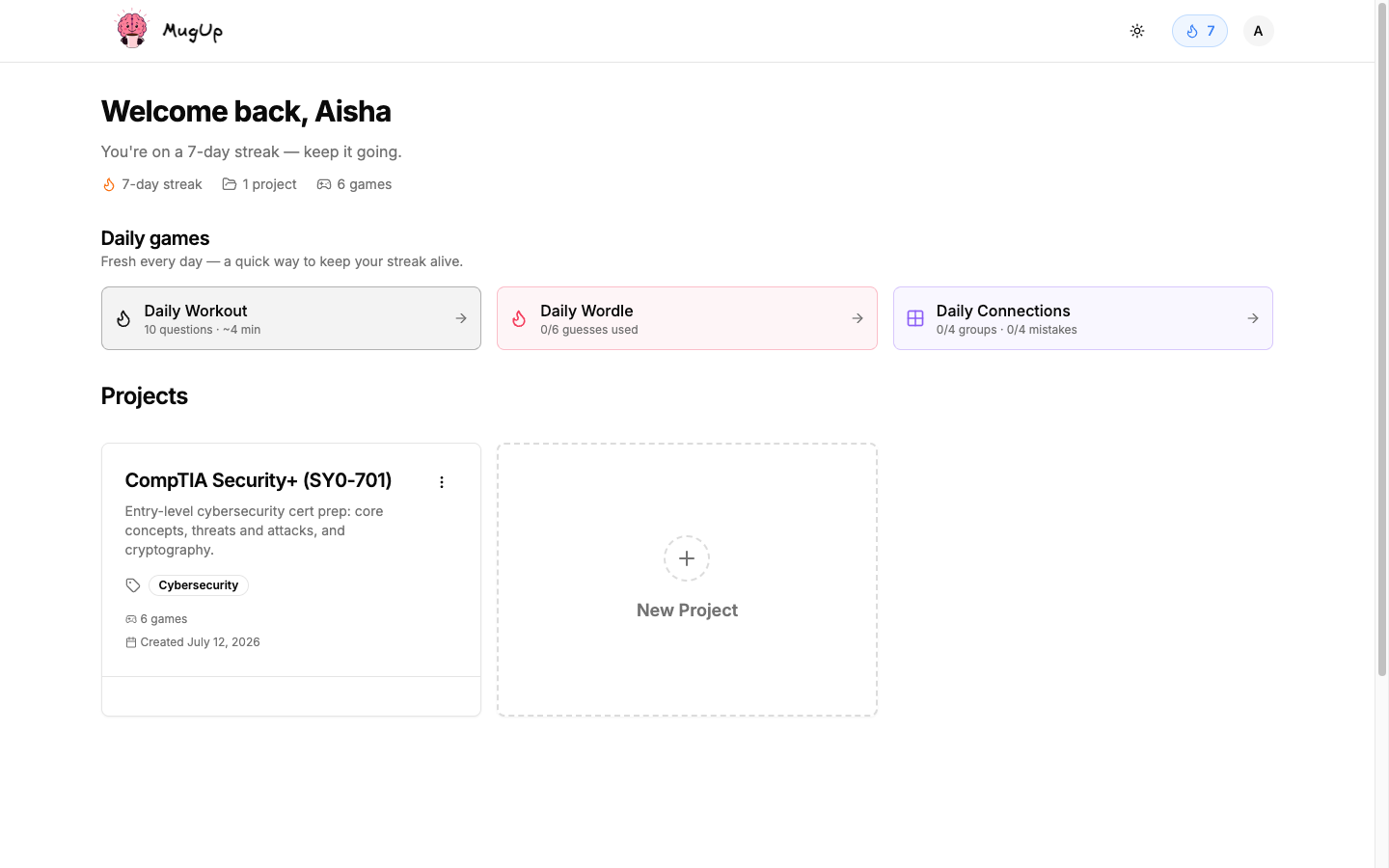
Rather than building hundreds of cards by hand, type a topic — "CIA triad and security concepts," "common cyber attacks," "cryptography basics" — and MugUp instantly creates quizzes, flashcards, and matching games. Practice recalling the definitions and attack types the exam leans on, keep a streak, and target whatever you keep missing. Low-stakes self-testing also tends to reduce exam nerves, so you walk in calmer.
Start free and build your Security+ deck today.
The takeaway
Security+ rewards broad, durable recall of concepts and threats under a mix of multiple-choice and hands-on questions. Study to the objectives, weight toward Security Operations, test yourself daily, and drill PBQs. For the overall strategy across any cert, see how to study for IT certifications without the grind.
Always confirm the current exam details on the official CompTIA Security+ page before you book.
Turn this into a game
Type a topic and MugUp's AI builds quizzes, flashcards, and matching games in seconds. Free to start.