Why Quizzing Yourself Is the Best Way to Study (and How to Make It Fun)
Rereading feels productive but fades fast. The science of retrieval practice shows that testing yourself builds durable memory — and can even make studying less stressful.
If you've ever reread a chapter three times, felt confident, and then blanked on the exam — you've met the limits of passive studying. The fix has a name in cognitive science: retrieval practice. Instead of putting information in over and over, you practice getting it out. It's the closest thing learning research has to a cheat code, and done right, it's genuinely fun.
The testing effect: getting it out beats putting it in
The foundational study is simple and famous. Henry Roediger and Jeffrey Karpicke had students study prose passages, then either restudy them or take a practice test with no feedback. On a test five minutes later, restudying looked better. But on the tests that actually mattered — two days and a week later — the students who had tested themselves remembered substantially more (Roediger & Karpicke, Psychological Science, 2006).
That last part is the key insight: rereading gives you a short-term illusion of mastery, while retrieval builds memory that lasts. The struggle to recall is the learning.
It even beats "smart" studying like concept maps
Maybe you think testing only works for rote facts. It doesn't. In a study published in Science, students who practiced retrieval learned more than students who used elaborative concept mapping — and the retrieval advantage held even on questions that required inference and deep understanding, and even when the final test was itself building a concept map (Karpicke & Blunt, Science, 2011).
Retrieval practice isn't just for memorizing definitions. It builds the kind of flexible, meaningful knowledge you can reason with.
Scientists ranked it a top-two technique
When five researchers reviewed ten popular study strategies for a landmark report, they rated most of what students actually do — highlighting, rereading, summarizing — as low utility. Only two techniques earned the top rating: practice testing and distributed practice (spacing your study out over time) (Dunlosky et al., Psychological Science in the Public Interest, 2013; accessible summary).
Combine the two — quiz yourself, then quiz yourself again a few days later — and you're using the two most effective study habits there are.
Wait — doesn't testing cause anxiety?
You'd think more testing means more stress. The research suggests the opposite, when the tests are low-stakes. In a survey of over 1,400 middle and high school students using classroom retrieval practice, 92% said it helped them learn and 72% said it made them less nervous for their real exams (Agarwal et al., 2014).
The reason makes sense: if you've already answered a question a dozen times in practice, the real exam is just one more rep. Familiarity replaces dread. This is why cognitive scientists distinguish retrieval practice (a learning tool) from high-stakes exams (an assessment tool) — the first makes the second less scary (retrievalpractice.org).
How to make quizzing yourself actually enjoyable
Retrieval doesn't have to mean grim self-interrogation. A few ways to make it fun:
- Turn it into a game. Points, streaks, and a timer turn drilling into something you want to come back to. Fun isn't a distraction from learning — it's what keeps you doing enough reps for the material to stick.
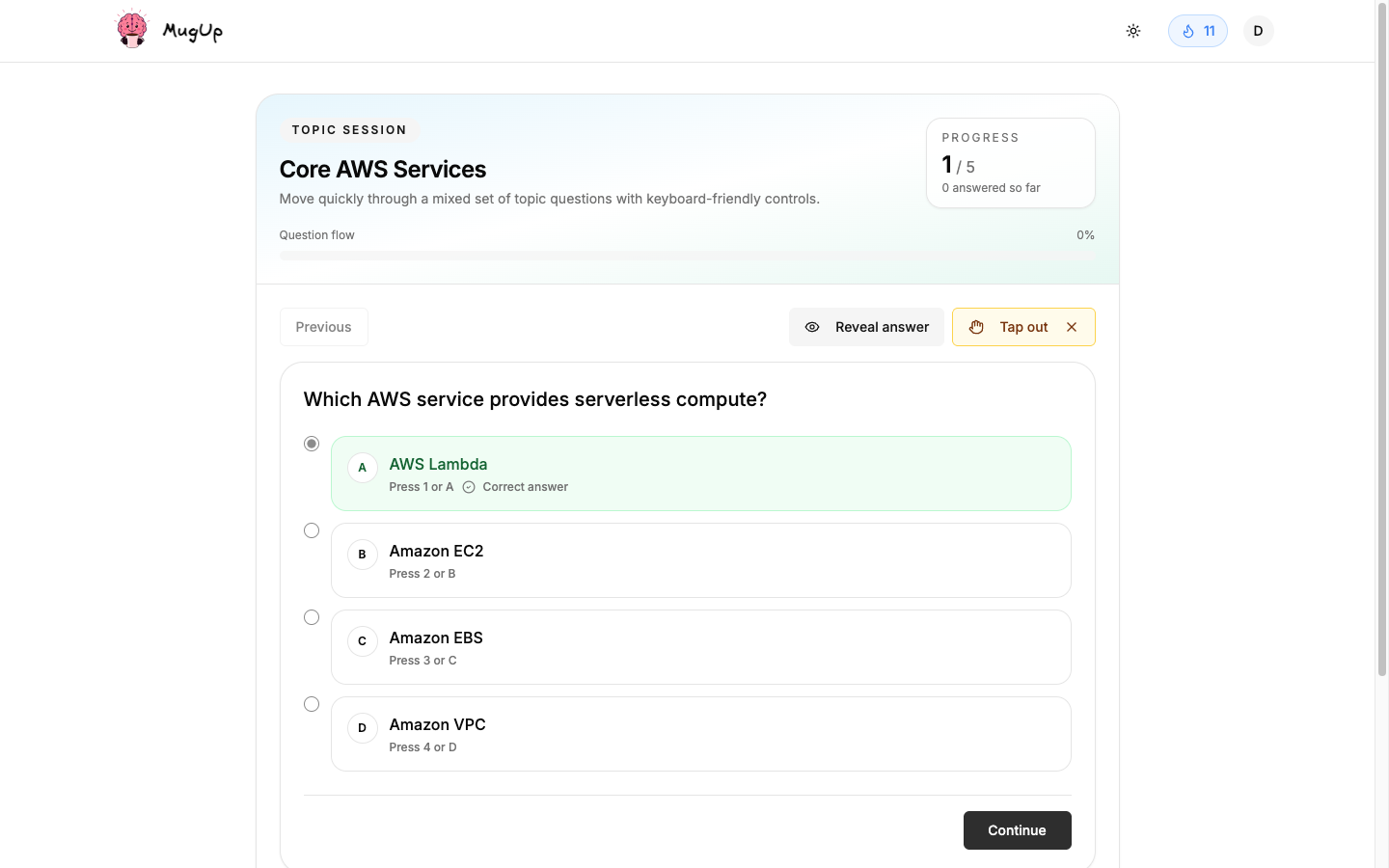
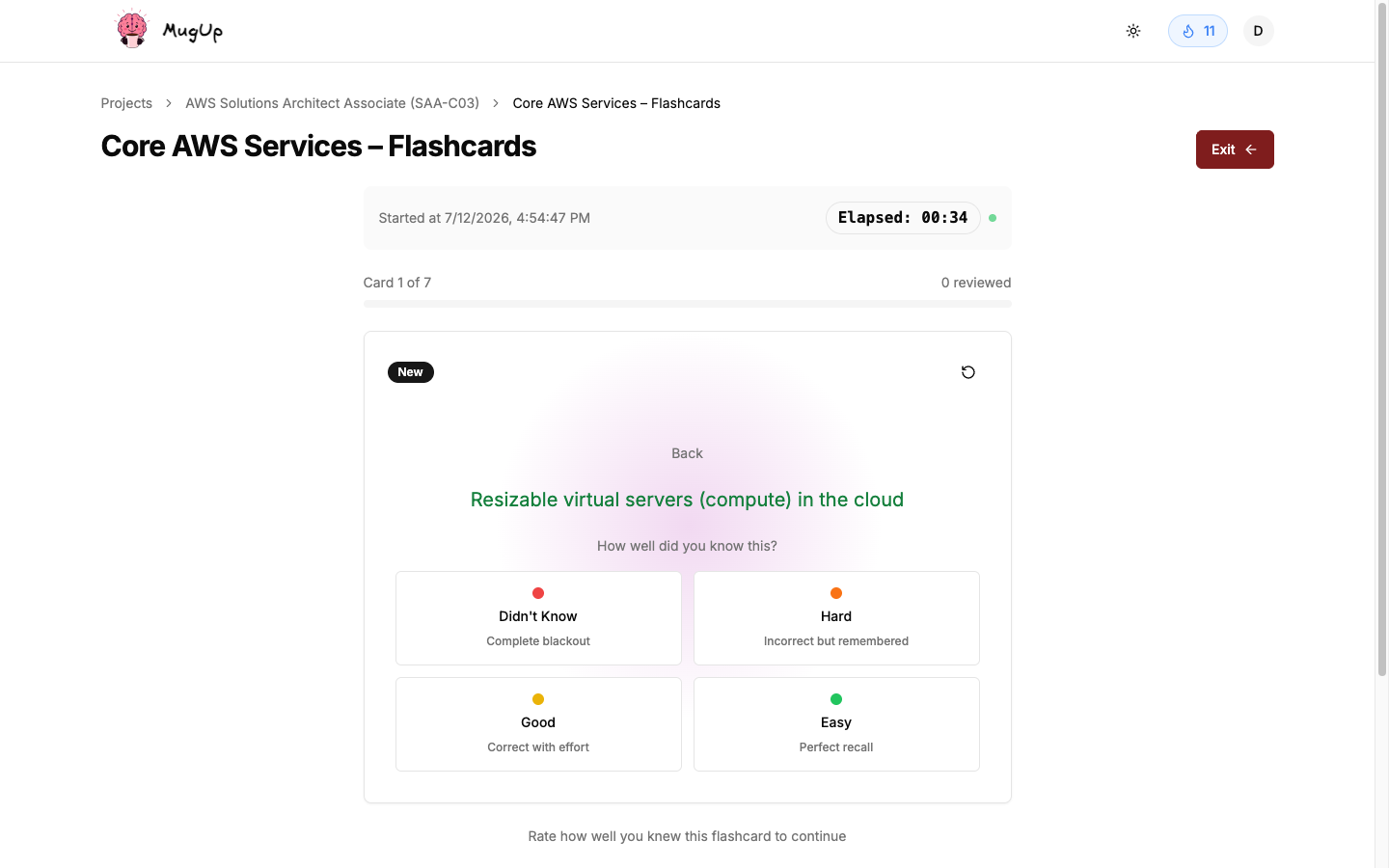
- Mix the formats. Flashcards for recall, multiple choice for spotting the difference between similar answers, fill-in-the-blank for producing an answer, matching games for lists. Variety keeps it engaging and covers more of what a real exam asks.
- Embrace getting it wrong. A wrong answer you then correct teaches you more than a right one you already knew. Track your misses and hunt them down.
- Quiz a friend, too. Retrieval works even better with social stakes — see why studying with friends helps you remember more.
Skip the busywork of making questions
The one real friction in retrieval practice is making the questions in the first place. That's exactly what MugUp automates: type any topic — from USMLE pharmacology to French verbs — and it instantly builds quizzes, flashcards, fill-in-the-blanks, and matching games. You keep a streak going, chase a high score, and study the way the science says works, without the prep.
Start free and turn your notes into a game today.
The takeaway
Stop rereading and start retrieving. Testing yourself builds durable, flexible memory, it's rated a top-two study strategy by researchers, and — done as low-stakes games — it can actually make studying less stressful and more fun. Quiz early, quiz often, space it out, and enjoy watching the material finally stick.
Sources
- Roediger, H. L., & Karpicke, J. D. (2006). Test-Enhanced Learning: Taking Memory Tests Improves Long-Term Retention. Psychological Science.
- Karpicke, J. D., & Blunt, J. R. (2011). Retrieval Practice Produces More Learning than Elaborative Studying with Concept Mapping. Science.
- Dunlosky, J., et al. (2013). Improving Students' Learning With Effective Learning Techniques. Psychological Science in the Public Interest.
- Agarwal, P. K., et al. (2014). Classroom-based programs of retrieval practice reduce students' test anxiety. retrievalpractice.org.
Turn this into a game
Type a topic and MugUp's AI builds quizzes, flashcards, and matching games in seconds. Free to start.