
How to Study for the AWS Solutions Architect Associate (SAA-C03) Exam
A focused study plan for the AWS SAA-C03: the four exam domains, the core services you must know cold, and how to drill them with quizzes and flashcards.
The AWS Certified Solutions Architect – Associate is one of the most valuable entry points into a cloud career. It's also broad: you're expected to know dozens of services and, more importantly, how to combine them into architectures that are secure, resilient, fast, and cost-effective. Here's how to prep efficiently.
Know the exam format first
According to the official AWS exam guide, the SAA-C03 is:
- 65 questions (15 of them unscored), multiple-choice and multiple-response.
- 130 minutes long.
- Scored on a scaled range of 100–1,000, with a passing score of 720.
It uses a compensatory model — you don't need to pass each section, just the exam overall. The questions are heavily scenario-based: expect "a company needs X, which design should you use?" rather than "define Amazon S3."
The four domains
The exam is organized into four domains (AWS certification page):
- Design Secure Architectures — IAM, encryption, security groups, least privilege.
- Design Resilient Architectures — multiple Availability Zones, load balancing, auto scaling, decoupling.
- Design High-Performing Architectures — choosing the right compute, storage, database, and caching.
- Design Cost-Optimized Architectures — Reserved Instances/Savings Plans, storage tiers, right-sizing.
Notice the pattern: it's always about choosing the right service for the requirement. That's what you should drill.
Services you must know cold
You can't reason your way through a scenario if you don't know what each service does. Lock these in first:
- Compute: EC2 (virtual servers), Lambda (serverless), Auto Scaling, Elastic Load Balancing.
- Storage: S3 (object storage, 11 nines of durability), EBS (block), EFS (file), S3 storage classes.
- Databases: RDS (managed relational, Multi-AZ for HA), DynamoDB (managed NoSQL), ElastiCache.
- Networking: VPC, subnets, security groups, Route 53 (DNS), CloudFront (CDN).
- Security & ops: IAM, KMS (keys), CloudWatch (monitoring), CloudTrail (audit logs).
Flashcards are perfect for the "service → what it does" mapping, and matching games nail "service → use case."
A four-week study plan
- Week 1 — Core services. Learn what each service does and make flashcards as you go.
- Week 2 — Resilience & performance. Multi-AZ, load balancing, auto scaling, caching. Turn each concept into questions.
- Week 3 — Security & cost. IAM, encryption, Reserved Instances, storage tiers.
- Week 4 — Scenario drilling. Shift almost entirely to multiple-choice practice, and re-quiz earlier weeks with spaced repetition so nothing fades.
Throughout, test yourself daily rather than rereading — retrieval practice is what makes it stick (here's the science).
Drill it with MugUp
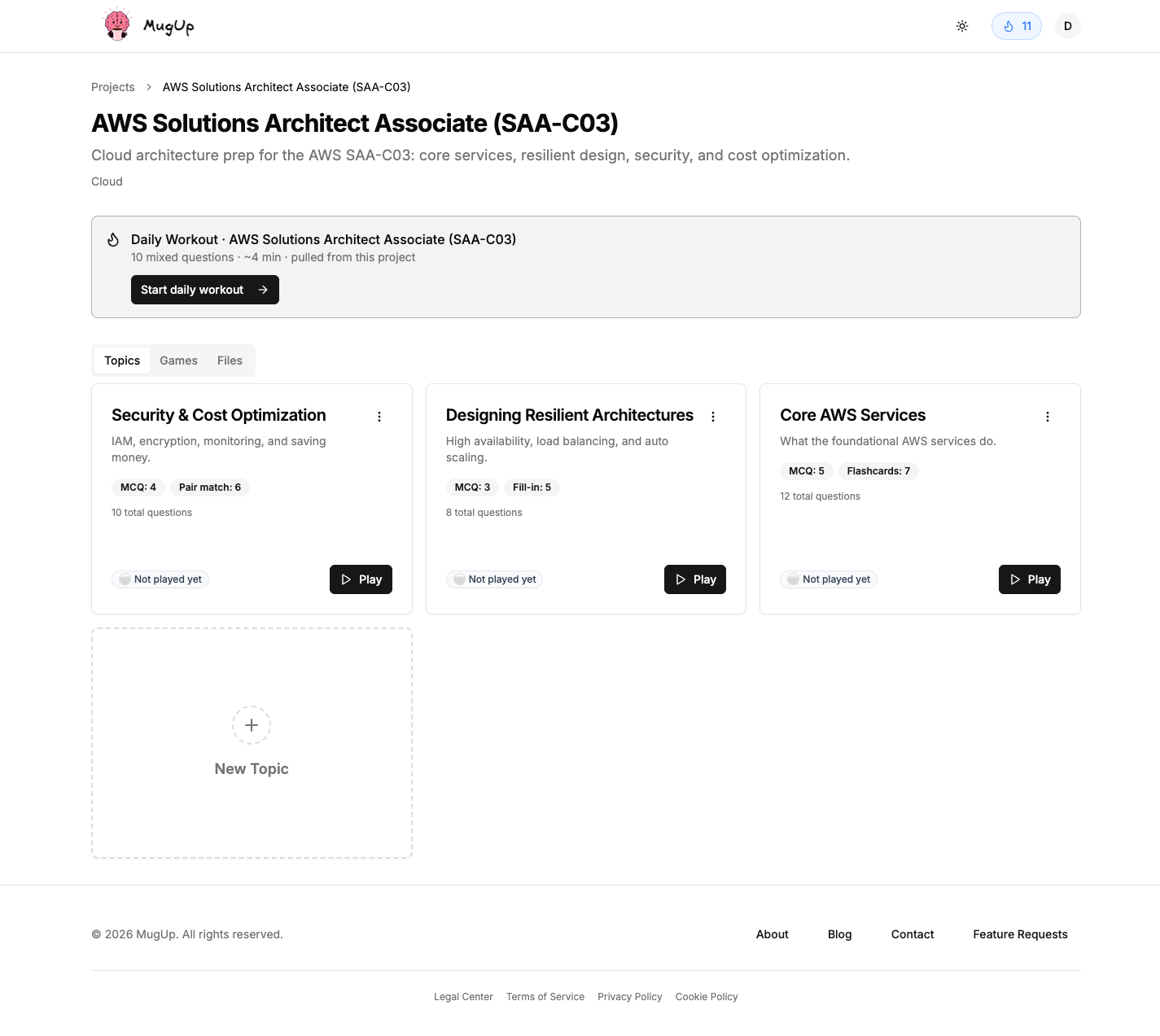
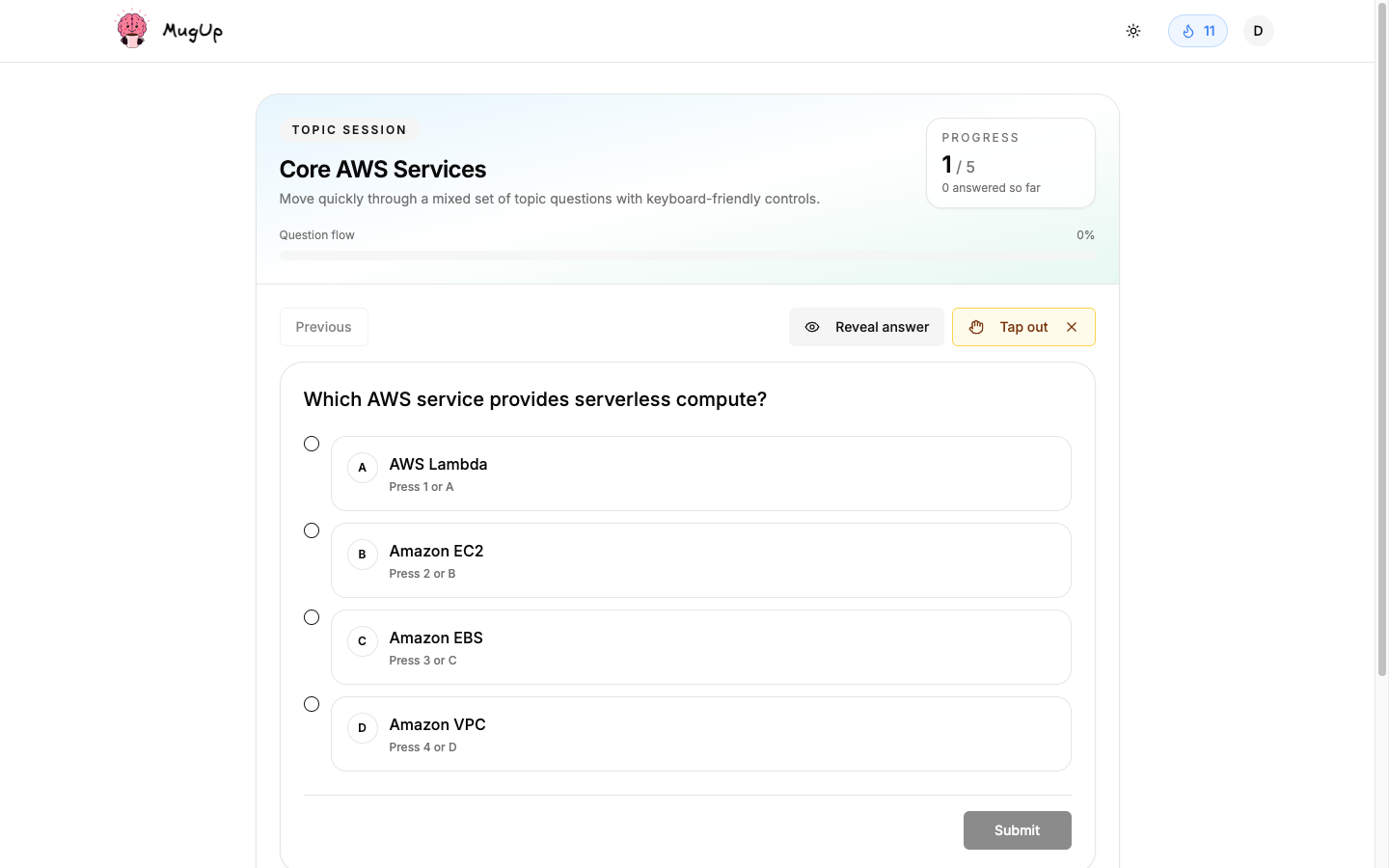
Instead of hand-making hundreds of cards, type a topic — "AWS core services," "designing resilient architectures," "AWS security and cost" — and MugUp instantly builds flashcards, multiple-choice quizzes, and matching games. Practice the "which service fits this requirement?" reflex the exam tests, keep a daily streak, and track the ones you miss.
Start free and build your SAA-C03 deck today.
The takeaway
The SAA-C03 rewards knowing your services cold and choosing the right one for each requirement. Learn the core services, drill scenarios in multiple-choice format, space out your reviews, and test yourself daily. For the bigger-picture approach, see how to study for IT certifications without the grind.
Always confirm the current exam details on the official AWS certification page before you book.
Turn this into a game
Type a topic and MugUp's AI builds quizzes, flashcards, and matching games in seconds. Free to start.