
How to Prepare for Coding Interviews With Flashcards and Spaced Repetition
Grinding LeetCode isn't enough. Here's how active recall and flashcards help you actually retain data structures, complexities, and system design for coding interviews.
Most engineers prep for interviews by grinding problems. That helps — but it has a blind spot. You can solve a graph problem today and completely blank on the time complexity of a heap operation next week. Problem-solving builds pattern recognition; it doesn't reliably build recall of the facts you need to reason quickly under pressure.
That gap is exactly what active recall fixes.
The facts you should have memorized cold
Before an interview, these should be instant, not something you derive on the spot:
- Time and space complexity of every common operation — array access, hash lookup, BST search, heap insert, sorting.
- When to reach for which data structure — stack vs. queue, hash map vs. balanced tree, heap vs. sorted list.
- Core algorithm templates — binary search, BFS/DFS, two pointers, sliding window, Floyd's cycle detection.
- System design vocabulary — load balancing, sharding, caching trade-offs, the CAP theorem.
None of these are hard. But if you hesitate on "what's the average lookup time in a hash table?" in a live interview, it costs you momentum and confidence.
Why flashcards work here
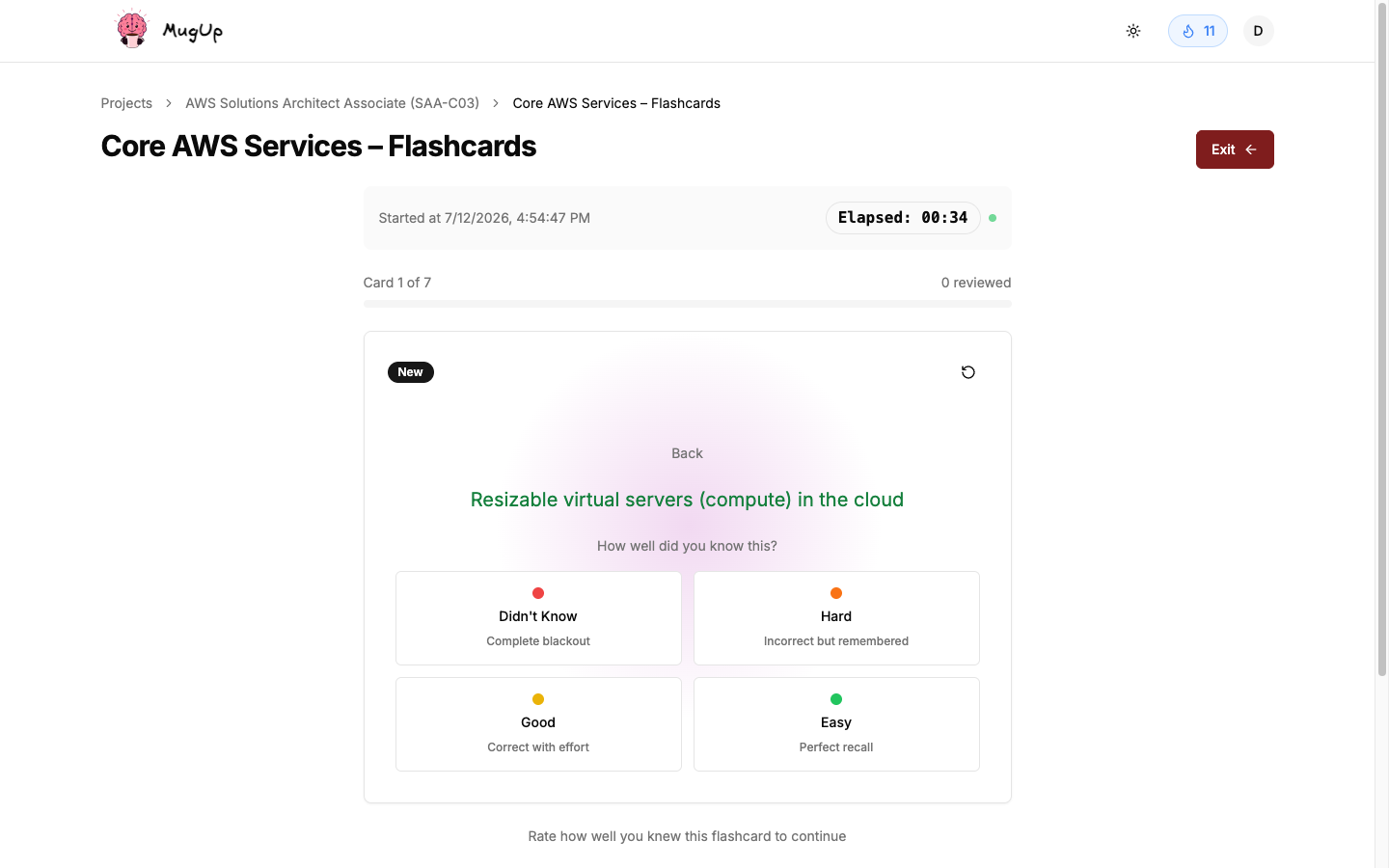
Flashcards are the ideal tool for one-to-one facts: prompt → answer. Paired with spaced repetition — reviewing a card right before you'd forget it — they let you lock in dozens of complexities and definitions with a few minutes of practice a day. That's far more efficient than rereading your notes the night before.
For anything with discrimination (choosing between similar options), multiple-choice questions train the exact skill you need. And matching games are perfect for drilling "data structure → operation complexity" as a set.
A two-week interview prep loop
- Keep grinding problems — that part doesn't change.
- After each problem, extract the reusable facts into cards: the complexity you looked up, the pattern you used, the edge case you missed.
- Review your deck for 5–10 minutes daily. Spaced repetition surfaces the cards you're weakest on.
- Add a system design deck if you're interviewing at that level — definitions, trade-offs, and example architectures.
By the time you walk in, the fundamentals are automatic and your working memory is free to focus on the actual problem.
Build your interview deck automatically
Writing cards by hand is the friction that makes most people quit. With MugUp, you describe a topic — "Big-O of common data structures" or "system design fundamentals" — and it generates the flashcards, quizzes, and matching games for you. Then you just practice.
Start free and create your first deck in under a minute.
The takeaway
Interviews reward speed and confidence on the fundamentals. Keep solving problems, but back it with a daily recall habit so the facts are never the thing that trips you up. Let the tool make the cards; you do the reps.
Studying for something else? Read how to study for the JLPT N5 or how med students beat the forgetting curve.
Turn this into a game
Type a topic and MugUp's AI builds quizzes, flashcards, and matching games in seconds. Free to start.